How Moisture Damages Electrical Cabinets — and Why Passive Protection Is Not Enough
Electrical enclosures present a paradox: they are sealed to exclude contaminants, yet that same sealing traps moisture inside. Temperature cycling — day-to-night, seasonal, or load-driven — causes the air inside a cabinet to alternately expand and contract, drawing in ambient humidity through gaskets, cable entries, and breather vents each time the enclosure cools. Over successive cycles, the cumulative moisture load can raise interior relative humidity (RH) well above ambient levels, even in cabinets rated IP54 or higher.
The failure mechanisms triggered by elevated enclosure humidity are well-documented across power distribution, automation, and telecommunications infrastructure:
- Surface condensation on PCBs and bus bars creates conductive moisture films that degrade insulation resistance, promote electrochemical migration between adjacent conductors, and accelerate corrosion of contact surfaces.
- Tracking and creepage failures become more likely as contamination combines with moisture on high-voltage insulator surfaces, reducing the effective creepage distance between live parts.
- Contact resistance increase in relay and contactor assemblies results from oxide and sulfide formation on silver and copper contact surfaces, leading to intermittent operation and, in severe cases, thermal runaway at contact points.
- Corrosion of structural components — busbar supports, DIN rail, cable trays — compromises mechanical integrity over multi-year timescales and complicates maintenance access.
Silica gel desiccants and passive breather filters address only the symptom — humidity ingress — without managing the moisture already present inside the enclosure. Once interior RH exceeds the dew point of cooler surfaces within the cabinet, condensation occurs regardless of passive barrier quality. Active dehumidification that continuously maintains interior RH below the condensation threshold is the only reliable long-term protection strategy for enclosures in humid, thermally variable, or outdoor environments. A Smart Cabinet Dehumidifier addresses this by continuously sensing and actively controlling enclosure humidity, eliminating the root cause of moisture-related failures rather than merely slowing their progression.
Thermoelectric vs. Compressor Dehumidification: Selecting the Right Technology for Enclosure Protection
Two fundamentally different refrigeration principles are used in cabinet-rated dehumidifiers, each suited to a distinct set of operating conditions. Understanding their performance envelopes is essential for correct specification.
Compressor-based dehumidifiers use a vapor-compression refrigeration cycle to chill a cold coil below the dew point, condensing moisture from the air stream. They offer high moisture removal capacity — typically measured in liters per day — and maintain performance across a wide humidity range. Their limitations in cabinet applications are mechanical: a compressor introduces vibration, requires periodic maintenance, and adds substantial volume and weight to an enclosure. In most electrical cabinet applications, these trade-offs make compressor-based units impractical.
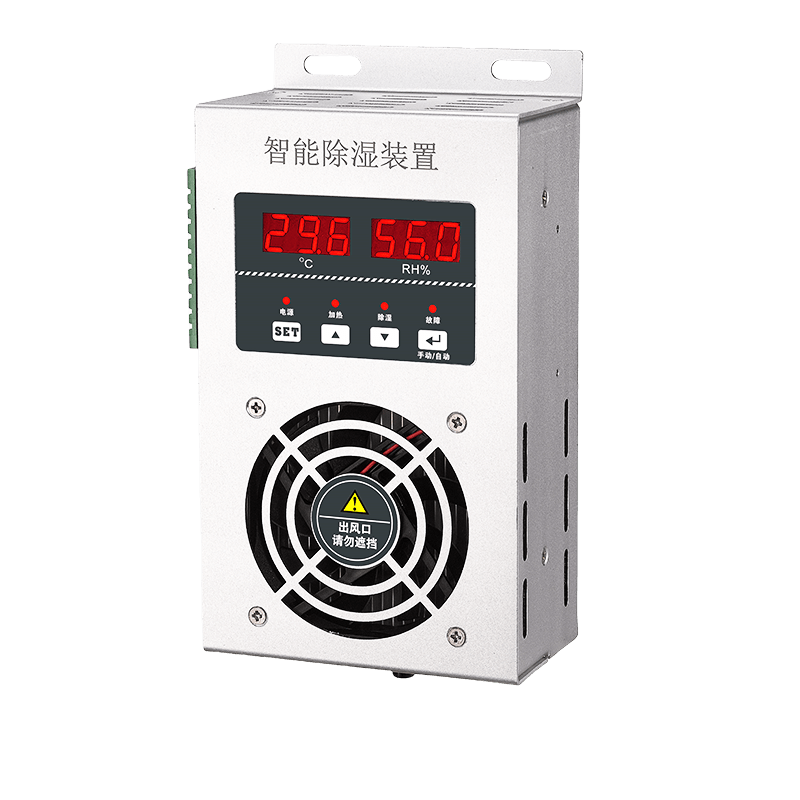
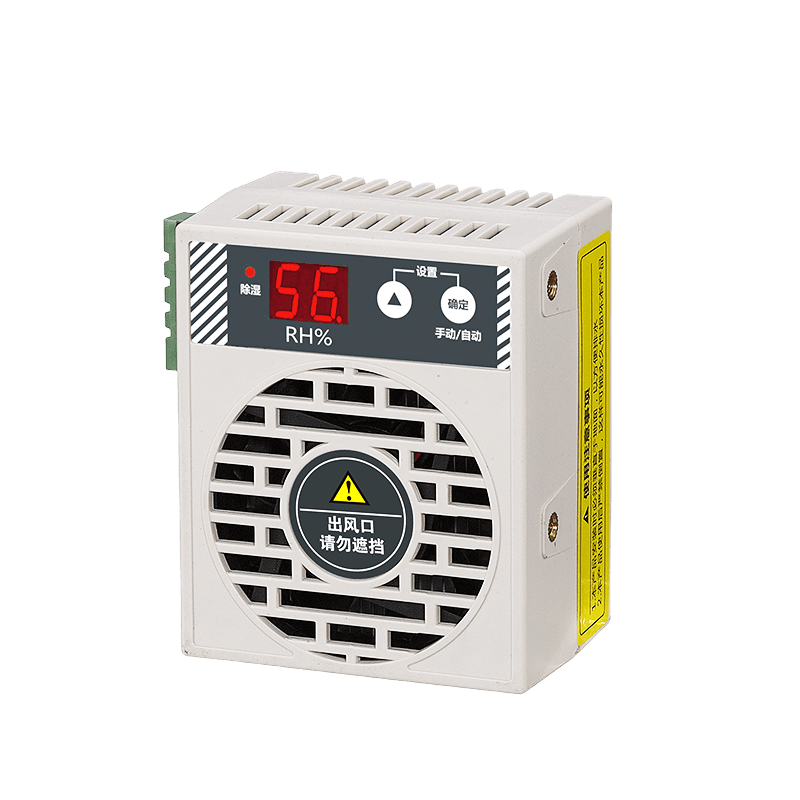
A Thermoelectric Dehumidifier for Electrical Cabinets — based on the Peltier effect — operates on an entirely different principle. When current passes through a thermoelectric module, one face becomes cold and the other becomes hot. Moist air passed over the cold face deposits condensate, which is collected and drained. The absence of moving parts, refrigerant, and compressor noise makes thermoelectric dehumidifiers uniquely suited to sealed electrical enclosures. Key performance characteristics include:
- Vibration-free operation — no mechanical wear mechanisms, critical for sensitive relay and measurement equipment co-located in the same enclosure.
- Compact form factor — DIN-rail or panel-mount configurations occupy minimal interior volume, leaving space for the primary electrical components.
- Low maintenance — no refrigerant recharge, no compressor oil, no filter replacement cycle beyond periodic inspection of the condensate drain path.
- Precise humidity control — thermoelectric modules respond rapidly to control signals, enabling tight RH setpoint regulation rather than the bang-bang cycling characteristic of compressor units.
The primary limitation of thermoelectric dehumidification is reduced efficiency at low ambient temperatures: condensation capacity drops as the differential between cabinet air temperature and cold-face temperature narrows. For enclosures in cold climates or unheated outdoor locations, specifying a unit with integrated anti-condensation heating is advisable to maintain effective moisture control through the full seasonal temperature range.
Intelligent Control Functions: What Smart Dehumidification Actually Delivers
The distinction between a basic dehumidifier and an Industrial Intelligent Dehumidifier lies in the control architecture that governs when and how the dehumidification element operates. Intelligent control translates directly into energy efficiency, enclosure protection reliability, and integration capability with plant-level monitoring systems.
Closed-loop humidity control is the foundational intelligent function. Rather than running continuously at full power, a smart dehumidifier measures enclosure RH via an integrated sensor and activates dehumidification only when RH exceeds a configurable threshold — typically set between 50% and 70% RH depending on the sensitivity of the enclosed equipment. This reduces power consumption significantly compared to always-on operation and avoids over-dehumidification, which in low-humidity environments can accelerate degradation of polymer insulators and seal materials.
Timed operation scheduling allows dehumidification intensity to be aligned with predictable humidity cycles. In many facilities, cabinet humidity peaks during nighttime low-load periods when enclosure temperatures drop and condensation risk is highest. Programming active dehumidification to increase capacity during these windows — and reduce it during high-load daytime hours when waste heat from power components naturally suppresses interior RH — optimizes energy use without compromising protection.
Local display and alarm output capabilities enable maintenance personnel to read current RH and temperature at the enclosure without accessing a remote monitoring system. High-humidity alarm contacts allow integration with plant SCADA or building management systems, generating maintenance alerts before RH levels approach the condensation threshold. ASY Electronics builds these intelligent control functions into its dehumidifier hardware as standard features, reflecting the broader platform philosophy of embedding actionable data at the edge rather than requiring centralized processing infrastructure to derive basic equipment health insights.
| Control Feature |
Basic Dehumidifier |
Intelligent Dehumidifier |
| Operation mode |
Continuous / manual switch |
Closed-loop RH setpoint control |
| Humidity visibility |
None |
On-device display + remote output |
| Alarm capability |
None |
Configurable RH alarm relay contact |
| Scheduling |
None |
Timed operation profiles |
| Energy consumption |
Fixed (always on) |
Demand-driven (reduced by 40–60%) |
Functional comparison between basic and intelligent cabinet dehumidifier control architectures.
Installation, Sizing, and Maintenance Practices for Long-Term Reliability
Correct installation and sizing are prerequisites for realizing the protection benefits of cabinet dehumidification. An undersized unit will fail to maintain the target RH setpoint during peak humidity events; an oversized unit may cycle excessively or create unnecessary thermal load inside the enclosure. Neither outcome represents the consistent, maintenance-free protection that the application demands.
Dehumidifier sizing for electrical cabinets should account for three factors: the internal volume of the enclosure, the expected ambient humidity and temperature range at the installation site, and the enclosure's IP rating — which determines the rate of moisture ingress under normal operating conditions. As a practical starting point, a thermoelectric dehumidifier with a condensate capacity of 0.25–0.5 liters per day is typically adequate for a sealed enclosure of 200–400 liters in a humid subtropical or coastal environment. For larger enclosures or those with frequent door openings — allowing direct exchange of ambient air — higher-capacity units or multiple dehumidifier nodes are warranted.
Positioning within the enclosure matters for effectiveness. Cold-face condensation efficiency is highest when the dehumidifier draws from the lower portion of the enclosure interior, where cooler, denser air accumulates. Mounting the unit in the lower third of the cabinet, with adequate clearance for condensate drainage, maximizes the driving temperature differential and reduces the energy required to reach the dew point on the cold face.
Condensate drainage must be reliably managed to prevent the collected moisture from re-evaporating inside the enclosure or pooling at the cabinet base. Gravity drainage through a sealed gland fitting to an external collection point is the preferred arrangement. In enclosures where external drainage is impractical, evaporative discharge using the dehumidifier's hot face — a feature integrated into many thermoelectric designs — eliminates the need for a physical drain path entirely. Periodic inspection of the drainage path for blockage remains the primary routine maintenance task; ASY Electronics designs its dehumidifier units to minimize this requirement through drainage channel geometry that resists particulate accumulation in industrial environments.