Tilt Sensing Technologies: Choosing the Right Measurement Principle
Not all inclinometers measure angle the same way, and the underlying sensing principle has direct implications for accuracy, drift behavior, dynamic response, and suitability for different installation environments. The three dominant technologies deployed in industrial and civil engineering applications each carry distinct trade-offs.
MEMS capacitive accelerometers are the most widely adopted technology in modern tilt sensors. They measure the component of gravitational acceleration along one or two sensitive axes and compute the inclination angle trigonometrically. Their key advantages are high resolution (often below 0.001°), compact form factor, and low power consumption. Sensitivity to vibration is the primary limitation: in environments with sustained mechanical excitation, MEMS-based sensors require digital filtering to separate quasi-static tilt from dynamic acceleration noise.
Electrolytic fluid tilt sensors use the position of a conductive liquid within a sealed cavity to detect inclination. They are inherently insensitive to high-frequency vibration — the fluid acts as a mechanical low-pass filter — making them well-suited for applications on vibrating machinery or seismic-prone structures. However, their measurement range is typically narrower, and temperature-driven fluid viscosity changes can introduce drift without active compensation.
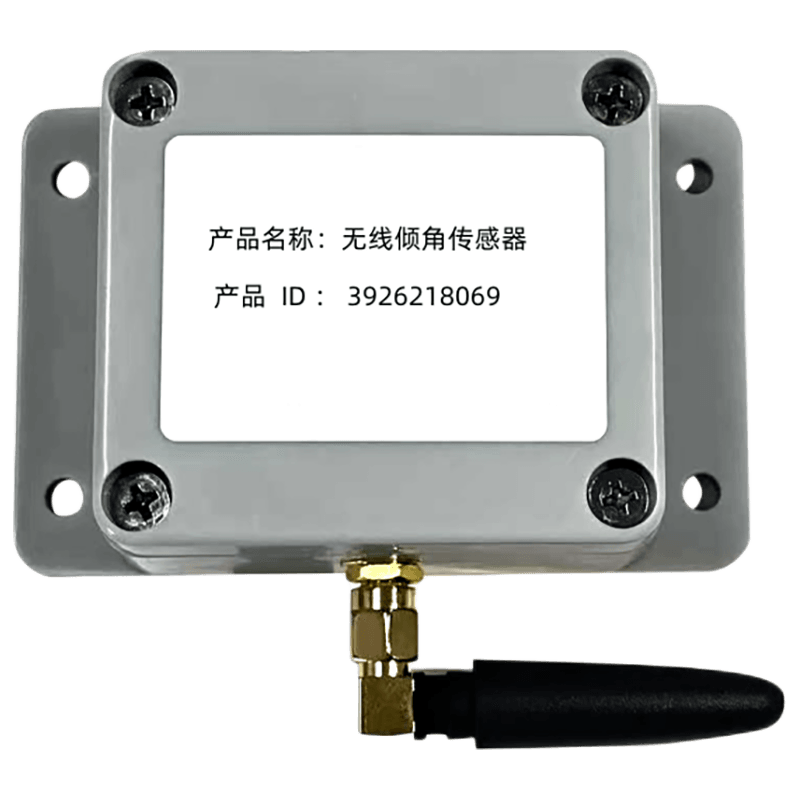
Fiber-optic inclinometers operate on interferometric or intensity-modulation principles, offering immunity to electromagnetic interference and the ability to function safely in explosive or chemically aggressive environments. They are the preferred choice for critical infrastructure monitoring — dam faces, mine shafts, high-voltage substations — where sensor longevity and intrinsic safety are paramount. A Wireless Tilt Sensor built on MEMS technology with robust on-board vibration compensation now delivers measurement performance that rivals electrolytic sensors across most industrial use cases, at significantly lower cost and with the added benefit of wireless connectivity.
Accuracy, Resolution, and Calibration: What the Specifications Actually Mean
Tilt sensor datasheets frequently conflate resolution, accuracy, and repeatability — three distinct performance parameters that determine fitness for purpose in different applications. Understanding the difference is essential when specifying a High-Precision Wireless Inclinometer for a demanding monitoring task.
- Resolution is the smallest angle change the sensor can detect and report. A resolution of 0.01° means the output will not change until the inclination shifts by at least that amount. High resolution does not imply high accuracy — a sensor can reliably detect 0.01° changes while having a systematic offset of 0.5°.
- Accuracy (or absolute error) describes how close the reported angle is to the true physical angle. It encompasses linearity error, zero-point offset, and temperature-induced gain variation. For structural health monitoring and geotechnical applications, absolute accuracy over the full measurement range and full operating temperature band is the controlling specification.
- Repeatability defines how consistently the sensor returns to the same output when returning to a known angle after excursion. High repeatability is critical in applications where relative change — not absolute position — is the monitored variable, such as tracking long-term settlement or foundation rotation.
Temperature compensation deserves particular attention. MEMS sensors exhibit gain and offset drift with temperature that can dwarf the structural movements being monitored. Sensors rated for industrial deployment should specify their temperature coefficient of offset (TCO) and temperature coefficient of sensitivity (TCS) explicitly. A TCO of 0.003°/°C across a 60°C operating range produces a worst-case thermal error of 0.18° — significant in applications where the expected structural displacement corresponds to fractions of a degree. ASY Electronics addresses this through on-chip temperature sensing paired with factory calibration coefficients applied in firmware, ensuring that reported angles reflect true inclination rather than thermally induced measurement artifacts.
Structural Health Monitoring: Deployment Patterns and Alert Logic
In structural health monitoring (SHM), tilt sensors are typically deployed not as standalone instruments but as nodes within a spatially distributed measurement network. The diagnostic value lies not in any single sensor's reading but in the differential tilt pattern across an array of measurement points — a pattern that can localize load redistribution, foundation settlement, or progressive structural damage more precisely than any global deformation indicator.
Common deployment architectures include:
- Vertical column arrays — sensors installed at regular height intervals on bridge piers, building columns, or retaining walls to detect bending curvature profiles and identify the elevation of maximum deformation.
- Foundation perimeter grids — sensors at each corner and midspan of a structure's foundation to detect differential settlement and identify which sections are undergoing preferential subsidence.
- Slope and embankment transects — sensors installed at depth intervals along slope cross-sections to monitor rotational slip surface development in geotechnical applications.
Alert thresholds in SHM deployments are typically structured in tiers. A first-level threshold triggers automated logging at elevated sampling frequency to capture the temporal evolution of the tilt event. A second-level threshold initiates engineer notification. A third-level threshold triggers emergency response protocols. Critically, thresholds should be defined relative to each sensor's established baseline, not in absolute angular terms, since different structural elements within the same project will have different initial inclinations and different rates of acceptable long-term drift.
Industrial Equipment Monitoring: Beyond Construction Applications
While civil engineering and construction represent the most visible use cases for tilt sensing, the technology delivers substantial value across a broader range of industrial asset monitoring applications that are often less prominently discussed. An Industrial Wireless Tilt Sensor Node with low-power wireless transmission enables cost-effective monitoring across asset classes where wired instrumentation is impractical.
Heavy rotating machinery alignment is one area where tilt monitoring adds a preventive maintenance dimension that vibration analysis alone cannot provide. Base plate tilt changes of as little as 0.05° can indicate foundation settling or bolt loosening in pump and compressor installations, often preceding detectable vibration anomalies by weeks. Continuous tilt monitoring at the machine foot level provides an early indicator that triggers targeted inspection before misalignment progresses to bearing or coupling damage.
Storage tank and silo integrity monitoring represents a growing application in chemical processing and bulk materials handling. Differential tilt across the base of a large-diameter storage vessel can signal uneven foundation support or localized wall deformation. Compared to manual survey methods, continuous wireless tilt monitoring dramatically reduces inspection frequency and provides real-time data during dynamic loading events — filling, discharge, and seismic excitation — when deformation risk is highest.
Mobile and lifting equipment safety systems rely on tilt sensing to enforce safe operating angle limits. Cranes, aerial work platforms, and mobile drilling rigs require real-time inclination feedback to prevent tip-over incidents. In this context, sensor response speed and fail-safe behavior under sensor fault conditions are the dominant specification requirements, rather than long-term drift stability. ASY Electronics designs its tilt sensor nodes to address the full spectrum from slow-drift structural monitoring to dynamic safety interlock applications, supporting the diverse needs of modern manufacturing and infrastructure management.